
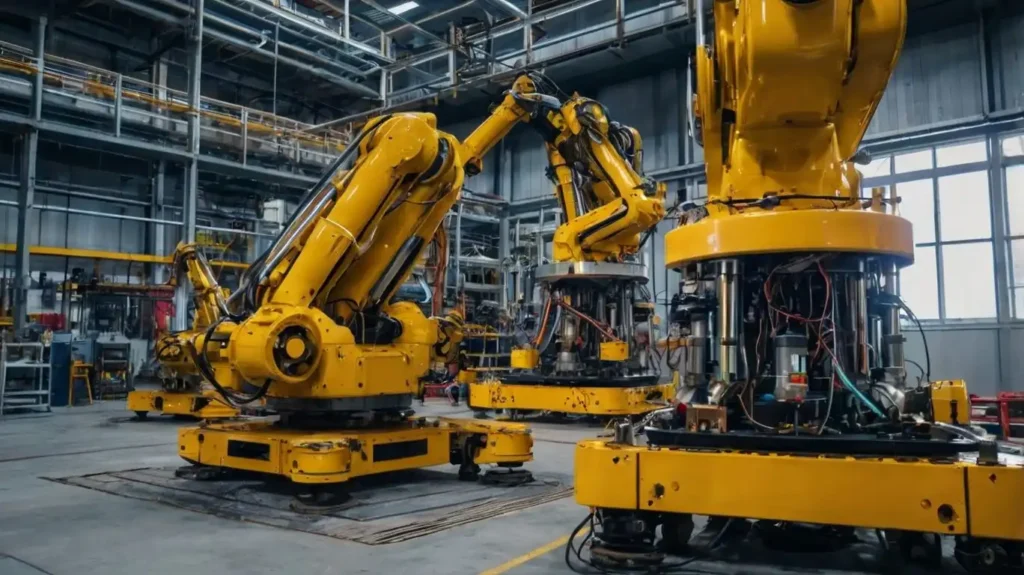
“The safest barrel is the one drilled by a robot that never blinks, never slips, and never forgets its training.”
What began with remotely operated vehicles giving engineers eyes and hands subsea has evolved into something far more powerful. Today’s robotics revolution in oil and gas is no longer about remote control—it is about autonomy, intelligence, and predictive decision-making.
Driven by edge AI, cloud analytics, and high-bandwidth connectivity, the global oil and gas robotics market is expanding rapidly, forecast to grow from USD 1.9 billion in 2023 to USD 6.0 billion by 2034. The fastest adoption is happening in autonomous inspection, monitoring, and maintenance systems, now active on roughly one in four offshore installations worldwide.
Robots on the Ground: Always-On Safety
Quadrupedal robots have become permanent members of offshore crews. On FPSOs and processing facilities, these autonomous systems patrol hazardous zones daily, performing thermal scans, gas detection, and high-resolution mapping without exposing personnel to risk.
Deployments on major offshore assets have achieved full inspection coverage in red zones, eliminated manual flare-stack inspections, and reduced unplanned shutdowns. In Nigeria, locally operated crawler programmes are now reducing hydrogen sulphide exposure and manual reading errors across swamp and shallow-water operations—while building domestic technical capacity.
Eyes in the Air: Smarter, Faster Inspections
Aerial drones equipped with AI analytics have transformed asset inspection. What once required rope-access teams and full shifts can now be completed in under an hour.
Advanced sensors detect corrosion beneath insulation, measure structural deformation with millimetre precision, and flag anomalies in real time. Operators using drone-led inspection programmes report significant cost reductions alongside zero lost-time injuries—demonstrating that safety and efficiency are no longer trade-offs.
A Robotic Drill Floor
Robotics is also reshaping drilling operations. Automated pipe-handling systems now perform tasks once carried out by multiple crew members in high-risk zones. Vision-guided torque systems ensure precision make-up, while predictive algorithms prevent thread damage and equipment failure.
Remote operation centres allow a single operator to supervise multiple rigs, accelerating tripping speeds, reducing personnel exposure, and delivering measurable annual cost savings per rig.
Permanent Residents on the Seabed
Perhaps the most profound shift is happening subsea. Resident robots now live on the seabed, housed in docking stations and activated only when needed. These systems autonomously inspect, intervene, and repair subsea equipment without halting production or mobilising vessels.
With inductive charging, intelligent navigation, and growing reliability, these underwater robots are moving subsea operations from reactive intervention to continuous presence.
Data Is the New Safety Layer
Every robotic system is also a data engine. AI-driven analytics process vast streams of vibration, acoustic, and thermal data to predict failures before they occur, identify leaks faster than manual methods, and trigger automated safety responses.
Operators adopting predictive robotics platforms are reporting lower maintenance costs, higher uptime, and stronger operational resilience across their assets.
Nigeria’s Opportunity: Local Talent, Global Technology
Robotics and automation are no longer the exclusive domain of expatriate teams. Training and certification programmes are equipping Nigerian engineers and technicians to operate, maintain, and optimise advanced robotic systems to international standards.
Ongoing initiatives are combining robotics deployment with renewable-powered charging systems, joint technology trials, and local fabrication support—positioning Nigeria as a competitive hub for next-generation offshore operations.
Managing the Risks
As robotics adoption accelerates, challenges remain. High upfront costs are being addressed through leasing and service-based models. Harsh environments demand ruggedised hardware and advanced thermal management. Cybersecurity is becoming mission-critical, requiring zero-trust architectures and industrial security compliance. Workforce adoption is supported through simulation training and phased integration.
The Bottom Line
AI-driven robotics is no longer an experimental add-on—it is fast becoming a core pillar of safe, efficient, and competitive oil and gas operations. From autonomous patrols offshore to resident subsea robots, machines are taking humans out of harm’s way while delivering faster execution and deeper insight.
The safest barrel is no longer a metaphor. It is increasingly the one drilled, monitored, and maintained by robots that never blink.